









Fresh Trend vs Exhausted Trend: Are You Entering the Stock Too Late?
The Stock Is Already Up 8%. Is It Still a Good Entry?
You find a stock that looks extremely bullish.
• The chart is strong.
• Momentum is visible.
• Everyone is talking about it.
Naturally, you think:
“Should I enter now?” But a more important question is “When did this trend begin?”
A stock can remain bullish and still offer a poor entry if a large part of the move has already occurred. This is why understanding the age of a trend matters.
A Trend Has Different Stages
A trend can broadly move through four stages:
Beginning → Developing → Established → Mature
Eventually, momentum may slow, price may consolidate or the trend may reverse.
Instead of only asking:
“Is this stock bullish?”
Ask:
“At what stage of the trend am I seeing it?”
Fresh Trend vs Established Trend
Suppose two stocks are bullish.
• Stock A has only recently started moving.
• Stock B has already risen consistently for several sessions.
Both may remain technically bullish, but their entry conditions are different. Stock B may already be far from its earlier support level, which can weaken the available risk-reward.
The stronger the previous move, the more carefully the current entry should be assessed.
| Fresh Trend | Established Trend |
|---|---|
| Move started recently | Move has continued for several sessions |
| Price may be closer to support | Price may be extended |
| Requires confirmation | Requires careful risk assessment |
| May offer an earlier opportunity | May involve a late entry |
How NeoTrader’s Age Movement Helps
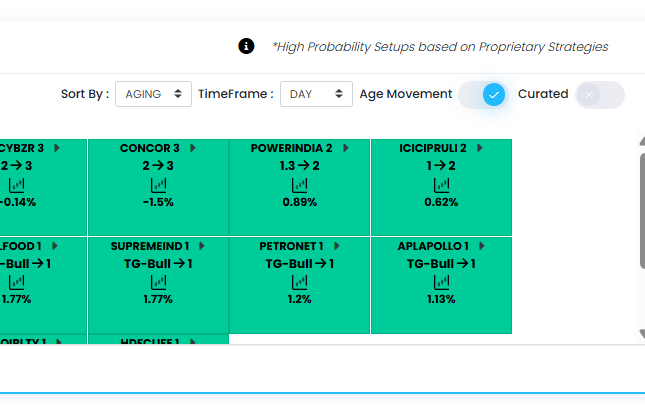
NeoTrader’s Age Movement feature shows how long a stock has remained active in its current directional trend. For example:
Day 1
The trend is comparatively fresh.
Day 2
The direction has continued into another session.
Higher Day Count
The trend has already been active for longer.
The objective is not to automatically buy every Day 1 stock. It is to understand:
“How mature is this move?”
NeoTrader may also display readings such as 4.3, indicating four days of directional movement followed by three days of sideways behaviour. This helps traders identify whether the trend is continuing or has started consolidating.
Why Traders Often Enter Late
Fresh trends do not always look exciting. The stock may have only started moving, and there may not be dramatic candles or widespread discussion.
After several strong sessions, the trend becomes obvious. The trader now feels safer—but the price may already be significantly higher. This creates a common pattern:
Fresh Trend: “I’m Not Sure Yet.”
Mature Trend: “Now It Looks Strong. I Should Enter.”
That is how traders sometimes end up chasing trends.
Bullish Does Not Always Mean a Good Entry
Suppose a stock begins its bullish move near ₹500. After several sessions, it reaches ₹560. The trend may still be bullish, but the nearest logical stop-loss may now be much lower.
A trader entering near ₹510 and another entering near ₹560 are looking at the same trend from very different risk positions.
This does not mean every fresh trend should be traded. It means fresh trends may deserve attention before the move becomes obvious to everyone.
Use Trend Age With Market Context
Trend age should not be studied in isolation. Before acting, ask:
• Is the broader market supportive?
• Is the stock’s sector participating?
• Is momentum continuing?
• Is the current price already extended?
• Does the risk-reward still make sense?
NeoTrader’s Active Stocks section identifies directional conditions such as Well-Set Bull and Well-Set Bear.
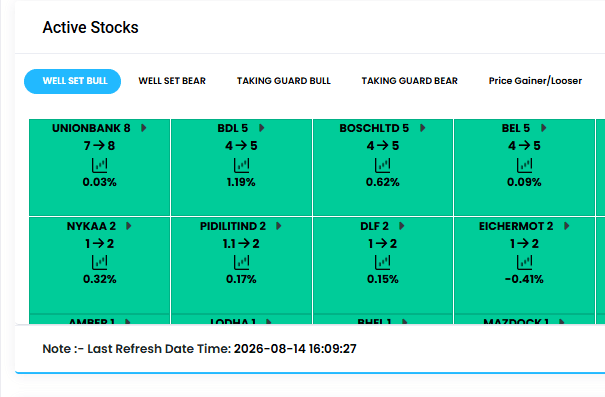
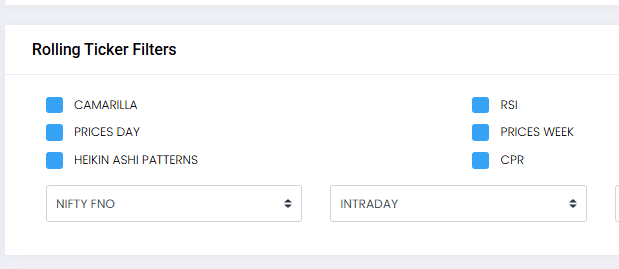
Age Movement adds another layer by showing how long that condition has remained active. Rolling Ticker can then help monitor whether directional momentum is continuing.
The workflow becomes:
Market → Sector → Trend Age → Confirmation → Risk
Can an Older Trend Continue?
Yes. A Day 5 reading does not mean that the stock must reverse the next day. Strong trends can continue longer than expected. Age Movement should not be treated as a reversal predictor.
It Provides Context, Not Certainty.
The better question is:
“Considering how far the trend has already moved, does the current entry still offer acceptable risk-reward?”
Age shows how long the trend has existed. Momentum tools help assess whether the trend still has strength.
Conclusion
Finding a bullish or bearish trend is only one part of technical analysis. The next question should be:
“How old is this trend?”
A fresh trend and a mature trend can offer very different trading situations, even when both appear bullish. NeoTrader’s Age Movement helps show how long a directional move has remained active.
Combined with the Dashboard, sector analysis, Rolling Ticker and Stock Analyzer, it can add useful context before a trading decision.
Don’t only ask whether a stock is trending.
Ask when the trend began—and whether the current entry still makes sense.
Understand the Trend Before Entering
Want to see how Age Movement, Active Stocks and Rolling Ticker work together inside NeoTrader? Book a personalised NeoTrader walkthrough with our team.
(Disclaimer: For educational and informational purposes only. Trading and investing involve market risk. Trend age, technical indicators and platform signals do not guarantee future market performance.)
Like what you see? Share with a friend.


